Unlocking High-Return Potential in a Shifting Energy Economy
November 24, 2025
If you love what you do for work, it’s not a job, but rather it’s a reward for implementing skills you have learned through life. As I got started in 2006 in oil and gas exploration with Millennium Exploration Company, I did not realize how the journey would evolve or how we would even survive the ups and downs of the oil and gas cycle.
What I did learn is that our processes, investments, and projects differ, as we focus on distressed projects, wells, and areas where we see potential to offset wells or to address maintenance issues in oil and gas assets. This key focus on rebuilding neglected or underperforming assets is like how a Real Estate agent looks at a home that has been poorly managed but has great upside.
While recently talking with investors and partners in the oil and gas markets, I was prompted to start a series of articles outlining what I am seeing in the industry, what it means, and how we will mobilize to take advantage of the markets.
Some key topics will include how real-world market conditions influence drilling activity, the ongoing shift in demand from oil to natural gas, and the varying cost structures across different basins.
The Dallas Fed Feedback From Oil Execs 2025
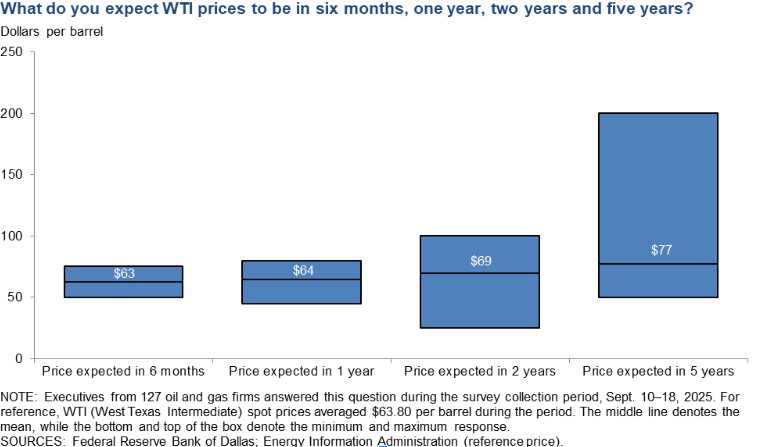
In September 2025, the Federal Reserve Bank of Dallas released an outstanding report from 127 oil executives, asking them where oil prices would be. Their response was insightful and cautious. While I like to be a realist, the world prices oil, and now natural gas, on a global market, and supply and demand are only one aspect of the pricing formulas. “Drill, Baby, Drill” may sound good on a campaign trail, but executives know that drilling at $60 WTI won’t get wells drilled in Alaska, and it will be basin-dependent.
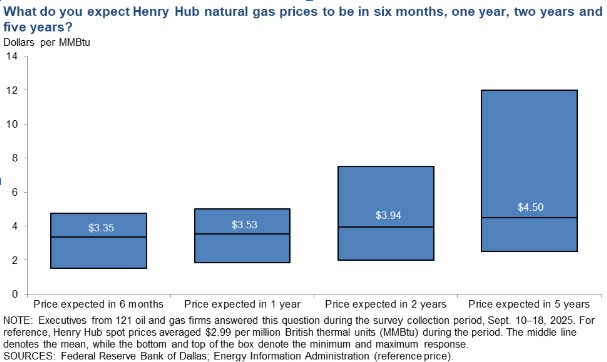
When we evaluate our projects, we have to factor in future oil and gas costs—not just today’s prices. These future prices (called the ‘strip’) help us decide whether a project is worth the investment. The Dallas Fed asked industry leaders what they expect these future prices to be, and those expectations help guide companies’ drilling budgets.
The question, ‘What do you expect Henry Hub natural gas prices to be in six months, one year, two years, and five years?’ is especially timely, as we’re already nearing the upper end of current expectations. Demand for natural gas continues to accelerate—driven not just by LNG exports (liquefied natural gas shipped overseas) but by the explosive growth of new data centers. For example, the Abilene, Texas, facility will operate behind the meter, purchasing its own natural gas directly. This approach bypasses transmission costs for consumers and shields the facility from new Texas regulations that allow the state or ERCOT—the Electric Reliability Council of Texas, which manages most of the state’s power grid—to curtail power to data centers during grid stress. It’s a clear sign of how rapidly the landscape is shifting—and why natural gas remains such a critical piece of the energy picture.
In the news last week, Chevron announced it was entering the utilities space, just as Liberty Energy did about 3 years ago. Changing their business model from just oil and gas exploration, or in Liberty Energy’s case, an oilfield service company, they are going after the consistent cash flow of the utility space. That is an excellent move for them, leveling out their cash flow and breaking into the utility space of electricity providers to data centers. This is a great long-term contract and cash flow leveling force on their balance sheets.
As Chevron’s Mike Wirth put it when asked about the outlook for oil and gas prices, “Never in my career have I seen a higher confidence outlook… The best is yet to come.”
Last week, the IEA had a U-turn
The IEA—the International Energy Agency, which provides global energy forecasts—revised its outlook last week. While there has been discussion about what prompted the shift, the important point is that the IEA’s updated outlook now aligns more closely with current market realities. Goldman Sachs echoed this sentiment in its latest projections, estimating global demand at 113 million barrels per day (BPD) by 2040, an increase from earlier forecasts. Their rationale is straightforward: the world’s transition to net-zero is moving more slowly than anticipated, and global economic growth continues to support long-term energy demand.
A central takeaway from the latest IEA report is that most oil and gas investment is now required not to meet rising demand but to counter natural declines in existing fields. More than 80% of global oil production comes from reservoirs that are already past their peak, making reworked wells and enhanced recovery techniques essential to sustain output and control costs.
These projects are a cornerstone of our strategy at Millennium Petrocapital. By focusing on rework and enhanced recovery opportunities, we’re able to pursue stronger returns—even in challenging market conditions—while extending the life and value of proven assets.

We’re encouraged that the IEA increased its demand forecast, bringing it more in line with the outlook from the EIA—the U.S. Energy Information Administration, which tracks and reports energy data. Even so, we rely on our own demand projections and market analysis when deciding how to move forward with new drilling and rework projects.
The Bottom Line:
As I opened this article, if you love what you do for work, it’s not a job; it’s a reward for using the skills you have learned through life. This is not a burden or a job in the traditional sense.
We are bringing low-cost energy to the Texas marketplace and providing returns to our stakeholders while having fun along the way. Our methodology enables us to provide services to oil and gas assets that have been overlooked or not managed as well as they should be. The key here is to look at assets with tremendous upside and minimal investment.
I will spend more time in future articles on processes and what is essential to investors and our industry. If you have any other topics you would like more information on, please let me or my team know, and we will get those questions answered.
For years, oil and gas prices were largely shaped by supply and demand. That dynamic shifted as OPEC and OPEC+ became more active in managing production, altering traditional pricing patterns. Now, we’re seeing the pendulum swing back. Market fundamentals are regaining influence, and global demand remains strong. Even the IEA now acknowledges that peak oil demand is far further out than previously suggested.
We’re paying close attention to consumption trends in China and India—the world’s largest importers. As long as their demand stays healthy, it supports a strong overall market outlook.
While we remain selective, exceptional opportunities are emerging for those who know where to look. As we close 2025 and roll into 2026, we’re launching several new projects and opportunities, and we’re excited to bring these offerings to market.
And as Mike Wirth of Chevron noted, the energy industry’s best days are still ahead. We share that outlook—and we’re proud to be part of shaping that future.
Author: Richard Monroy