Dallas Fed Survey Signals Lingering Pessimism in Oil and Gas Activity—But Is the Glass Half Full?
December 23, 2025
On November 24, 2025, I published “Unlocking High-Return Potential in a Shifting Energy Economy,” examining the processes, investments, and projects shaping the next phase of energy markets. At the time, the intent was to frame a long-term opportunity. What became clear only weeks later was how quickly geopolitical and macroeconomic forces would reinforce many of those conclusions.
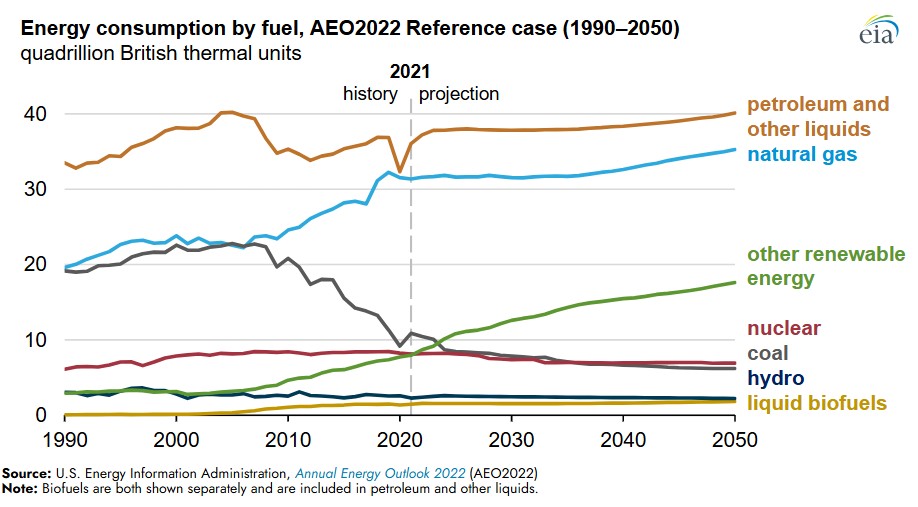
The United States remains on track for petroleum and natural gas to be the most utilized fuels through 2050, underscoring a fundamental reality: the energy transition will be evolutionary, not abrupt. This places a premium on maximizing recovery from existing assets—extracting more oil and gas from both new wells and the extensive inventory of producing wells already in place. The more we optimize established basins, the less capital-intensive exploration becomes. In a $60-per-barrel oil environment, this discipline defines a new operating paradigm for exploration and production companies.
The Dallas Fed December Energy Survey: A Cautious Industry
The Dallas Federal Reserve’s December 17 Energy Survey reinforces this view. Conducted between December 3 and 11, 2025, the survey gathered responses from 126 executives—86 from exploration and production (E&P) firms and 38 from oilfield services companies. The results reflect an industry exercising restraint amid persistent economic and geopolitical uncertainty.
The business activity index remained negative at -6.2, essentially unchanged from the prior quarter, signaling stalled momentum. Executives cited uncertainty around global demand, policy direction, and commodity price volatility as primary headwinds. While the company outlook index improved modestly to -15.2 from -17.6, it remains firmly in negative territory, reflecting continued caution.
Uncertainty itself remains elevated. The outlook uncertainty index held steady at 43.4, indicating reluctance among firms to commit to aggressive expansion plans. Production indicators tell a similar story: the oil production index improved marginally to -3.4 from -8.6, while natural gas production was flat at 0.
Service companies reported additional pressure. Equipment utilization declined to -12.2, and operating margins fell sharply to -31.7, highlighting the profitability squeeze across the services segment.
Structural Challenges and Cost Pressure
Executive commentary provides important context. Several respondents noted declining recoverable reserves in secondary zones of the Permian Basin, estimating 15–20% less recoverable oil than previously expected, which complicates long-term supply assumptions. Lower oil prices are pushing marginal wells out of economic viability, while geopolitical risks—including tensions surrounding China and Taiwan—and domestic policy uncertainty continue to weigh on sentiment.
Natural gas, in particular, is increasingly viewed as a cost center rather than a revenue driver. Concerns about oversupply persist, especially if sanctions on major producers are relaxed. On the cost side, some relief is evident: oilfield services input costs declined to 24.4 from 34.8, and lease operating expenses eased to 28.4 from 36.9, reflecting softer demand.
Price expectations remain subdued. Survey participants forecast WTI crude at $62 per barrel by year-end 2026, modestly higher than the survey-period average of $59, while Henry Hub natural gas is projected at $4.19 per MMBtu.
Looking ahead to 2026, capital spending plans are mixed. 39% of E&P firms expect capital expenditures to decline, 24% anticipate no change, and 37% project increases. Employment expectations mirror this caution, with a majority expecting flat headcount and more firms anticipating reductions than growth.
Efficiency, Not Expansion as the Path Forward
Despite this pessimistic backdrop, the survey also highlights where opportunity persists. Operators are increasingly focused on extracting incremental value from existing assets rather than pursuing capital-intensive new drilling programs. This approach aligns closely with Millennium PetroCapital’s strategy: acquiring distressed or under-optimized assets at attractive valuations and improving production economics through targeted interventions.
Well interventions—including workovers and recompletions—are central to this strategy. These techniques, which may involve wireline, coiled tubing, or snubbing operations, allow operators to restore, enhance, or extend well performance at a fraction of the cost of drilling new wells. When executed correctly, workovers can materially increase production, reduce downtime, and extend asset life.
Equally important are advances in completion design. Optimizing propped fractures and tailoring completion methodologies to access additional reservoir pay have enabled operators to outperform legacy wells in mature fields—often with compelling returns on incremental capital.
Technology and AI: Incremental Gains with Long-term Impact
Technology continues to amplify these efficiencies. Across the Permian Basin and other shale plays, operators are leveraging longer laterals, optimized well spacing, faster completions, and multi-well pad drilling to increase output per rig while reducing surface impact and cost.
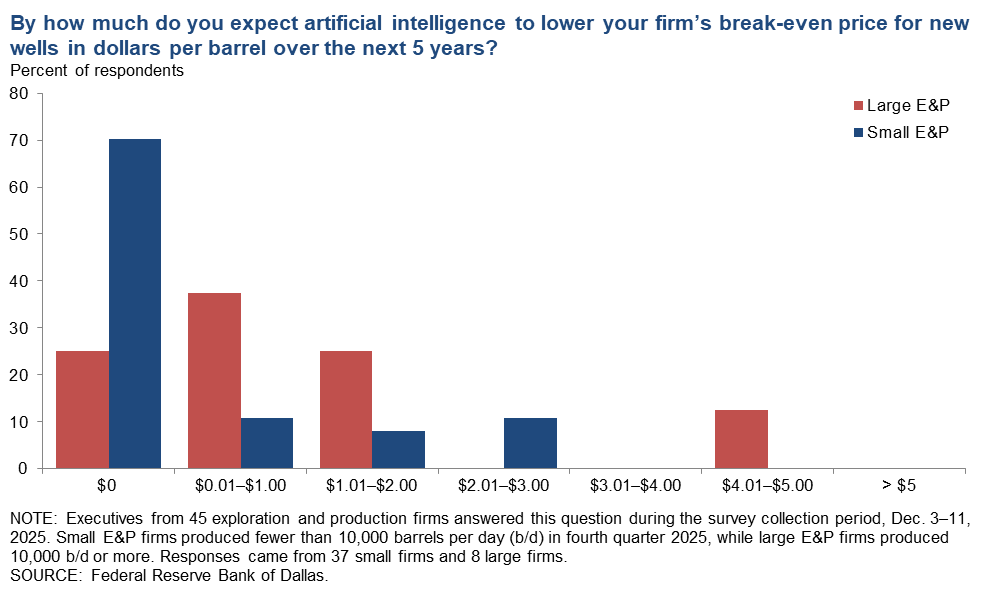
Data analytics and artificial intelligence are increasingly integrated into these workflows. Predictive maintenance, automated monitoring, and real-time optimization reduce unplanned downtime and operating expense. The Dallas Fed survey directly addressed this trend, asking executives: “By how much do you expect AI to lower your firm’s break-even price for new wells in the next five years?”
“Executives from small and large E&P firms have differing views on the potential impact of AI on break-even prices. The majority of executives at large E&P firms expect AI to provide some reduction to their firms’ break-even prices for new wells over the next five years. Thirty-eight percent of executives at large E&P firms anticipate reductions of $0.01–$1 per barrel, 25% expect $1.01 – $2.00 per barrel, and an additional 13% expect $4.01 –$5.00 per barrel. However, the majority of executives at small E&P firms expect AI will not lower their firm’s break-even price. (See table for more details.)”
Productivity Gains Are Already Evident
These efficiency gains are not theoretical. U.S. crude production is projected to reach 13.6 million barrels per day in 2025, even as the active rig count remains well below prior peaks. Advances in horizontal drilling and hydraulic fracturing have reduced per-barrel costs from approximately $32 per BOE in 2019 to around $21 per BOE since mid-2022.
This cost discipline has freed cash flow, enabling higher dividends and share repurchases—critical factors for attracting capital in a volatile macro environment. Intelligent completions further reduce the need for incremental drilling, improving recovery rates and lowering total field development costs.
Is the Glass Half Full?
For investors, these dynamics point to a more resilient operating model. Companies that prioritize efficiency, asset optimization, and disciplined capital allocation are better positioned to weather price volatility and geopolitical risk while delivering more predictable returns.
At Millennium PetroCapital, we continue to align our portfolio with these principles—focusing on enhanced recovery, operational excellence, and sustainable value creation. While industry sentiment remains cautious, opportunity persists for those willing to look beyond headline pessimism.
As the title suggests, the glass may indeed be half full. There remains substantial oil and gas that can be produced at lower costs from existing assets—benefiting investors, consumers, and the environment alike through improved efficiency and reduced surface impact.
We welcome dialogue and feedback. As we continue conversations with investors and industry peers, these exchanges help shape a more disciplined and resilient future for the energy sector.
Author: Richard Monroy